When Island Two Earns Its Keep — and When It Just Adds an Airport Day
Two islands in one Caribbean holiday has obvious appeal. You get the quiet one and the lively one, the beach bar and the rainforest, the ferry crossing and the story to tell back home. For UK travellers in 2026, with more direct routes and package options than a decade ago, the split stay can feel like a smarter use of a long-haul flight.
But moving is not free. Every island change has a cost in time, luggage admin and the small friction of unpacking twice. The question is not whether a twin-centre trip sounds lovely. It is whether the second island earns its keep.
The split stay looks better in the brochure
A photograph of two islands on one itinerary hides the middle bit: checkout, a taxi, a terminal, a wait, a crossing or a short flight, another taxi, another check-in. That middle bit is the second-island test. If it eats a morning, fine. If it eats a day, you need to be honest about what you are buying.
Start with door-to-door time, not flight time
The flight from one Caribbean island to another can be 35 minutes and still take half a day. What matters is the whole move from hotel A to hotel B. Add checkout, the taxi to the airport or ferry terminal, the recommended arrival time, the crossing or flight, baggage reclaim, the next transfer and the new hotel check-in.
A useful rule for UK planners: if the door-to-door move is under four hours, it can feel like a late breakfast and an early lunch. If it is over four hours, treat it as an airport day and budget accordingly. That is the four-hour question. Ask it before you fall for the second island's Instagram feed.
Ferries: the good, the slow and the weather-dependent
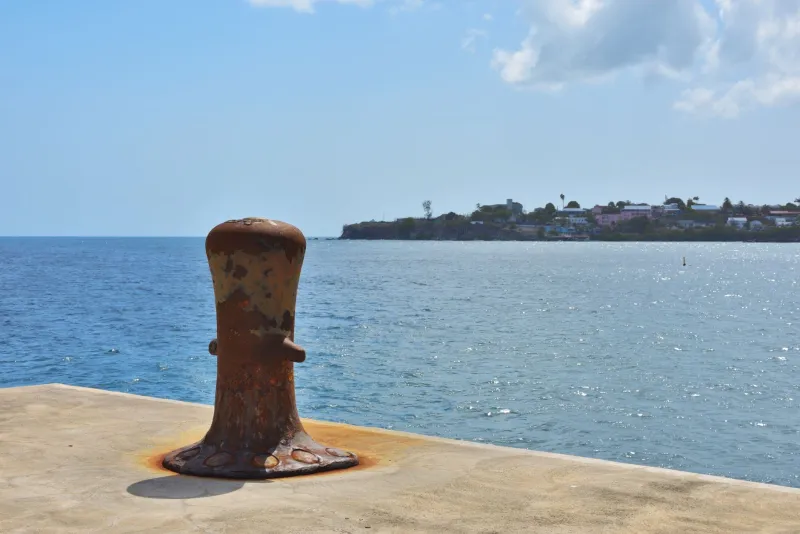
Short ferries are the best kind of island move. St Kitts to Nevis is a classic example: a crossing measured in minutes rather than hours, with the second island visible from the first. St Vincent to Bequia, Grenada to Carriacou and Guadeloupe to Les Saintes can all work well when the timetable suits your dates.
But Caribbean ferries are not all turn-up-and-go. Some run a few times a day, some less often on Sundays, and some are passenger-only. Check the last crossing before you book a late flight. Check luggage rules, because a ferry may be more relaxed than an inter-island flight but less relaxed than a long-haul carrier. Check whether your rental car can cross; usually it cannot, so you return it on the first island and pick up another on the second.
Winter swell can also rewrite the plan. A crossing that is smooth in April may be a different proposition in January. If you are prone to seasickness, a short flight may be worth the extra cost even when the ferry looks cheaper.
Inter-island flights and the baggage shuffle
Caribbean inter-island flights are practical, but they are not long-haul flights with a smaller cabin. Baggage allowances can be 20kg checked and 5kg to 7kg hand luggage, sometimes less on smaller aircraft. If your UK package includes 23kg, do not assume the second leg matches. Repack before you leave home, or budget for excess baggage.
Also check the airport experience. A 7am inter-island flight can mean a 5am hotel pickup, which is not much of a holiday morning. And if you are flying home from the second island rather than returning to the first, you are booking an open-jaw ticket. That can be sensible, but it can also cost more and complicate package protection. Ask your operator how the transfer and return flights are covered before you assume it is all one protected booking.
The minimum-stay maths
A seven-night trip split across two islands is usually a mistake. By the time you have lost half a day to the move and unpacked twice, you have two short breaks with a suitcase in the middle. The first island becomes a waiting room and the second becomes a countdown to the flight home.
A better starting point is ten nights or more for two islands. Give each island at least four nights, and preferably five. A 4/6 or 5/5 split gives you time to settle, find a favourite beach and eat somewhere twice. For a 14-night holiday, two islands is comfortable. Three is possible only if the moves are short ferries and you are happy with a more restless pace.
Pairings that pass the test
St Kitts and Nevis is the easy win: short ferry, no airport day, and a genuine change of pace without a genuine change of logistics. St Vincent and Bequia works for travellers who want a main island base and a smaller island finale, provided you check the ferry timetable. Grenada and Carriacou suits a slower trip. Guadeloupe and Les Saintes gives a French-Caribbean flavour with a short crossing, though you need to be comfortable with French-language timetables and local ferry rules.
Antigua and Barbuda can work, but Barbuda is not a mini-Antigua. It is quieter, more limited and more dependent on the ferry or a small flight. Do the research before you assume it is a simple add-on.
Pairings that usually fail
Barbados and St Lucia sounds like a dream double, but the move is an airport day rather than a ferry hop. On a 14-night trip it can be lovely. On a 7-night trip it is a stressful way to lose a day. Antigua and St Lucia has the same problem. Jamaica and Cuba brings visa and insurance complications that most UK holidaymakers do not need on a beach trip. Trinidad and Tobago can work, but the ferry and flight options need checking carefully, and Trinidad is not a typical fly-and-flop island.
When staying put wins
If your trip is under ten nights, stay put. If you are travelling in a tight school holiday window, stay put. If you have young children and a lot of luggage, stay put. If the second island can be done as a day trip, do that instead.
A day trip to Nevis from St Kitts, or a boat trip to a smaller island from your main base, gives you the twin-centre feeling without the hotel change. You still see two islands. You just sleep in one bed.
The second-island test is not about being cautious. It is about spending your holiday time on the things you flew for. If the move passes the four-hour question and the four-night rule, split the trip. If it does not, book one island properly and take the ferry for lunch.